Explainers
I am very interested in using AI to explain difficult ideas so that they become easy to grasp. AI can now build and implement things faster than ever, and I suspect that from here on, the one real bottleneck will be human understanding: whether people can actually follow what was built, and why it works.
How to loosen that bottleneck is a question I keep coming back to, and these explainers are one attempt at an answer. Each starts from something I wanted to understand myself, a lecture topic, a paper, or a question I got curious about, and turns it into a page you can see and play with. I do not know yet what the best answer looks like, but building these is how I am trying to find out.
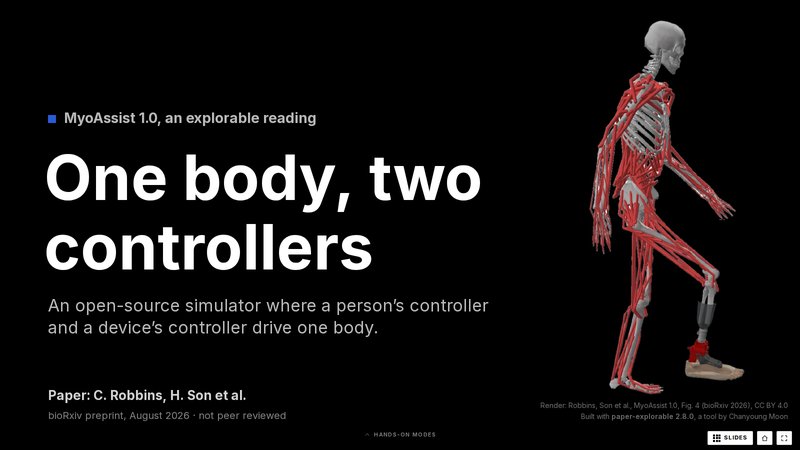
MyoAssist 1.0
One body, two controllers
Robbins, Son et al., bioRxiv preprint (2026)
I am interested in simulating exoskeletons and brain-computer interfaces, and I wanted to try a tool that can actually do it. Before using MyoAssist, I read the paper to understand how it lets a person's controller and a device's controller drive one simulated body.

Getting the Caffeine Out
How decaf coffee beans are made
A personal question
I love coffee, but even a single morning cup keeps me up at night. Before switching to decaf for good, I wanted to know how the caffeine actually gets out of the bean.

Why Are GPUs Fast?
From one core to the data center
Architecture & System for AI Seminar, Korea University
Parallel computing basics, GPU architecture and its history, and what happens inside a GPU during LLM inference and training.